From Action to Thing: Turning Samoan Verbs into Nouns with -ga
Here’s something nobody told me when I started learning Samoan: you already know more nouns than you think. Hidden inside almost every verb you learn is a noun waiting to come out, and the key that unlocks it is two letters long: -ga.
What -ga does
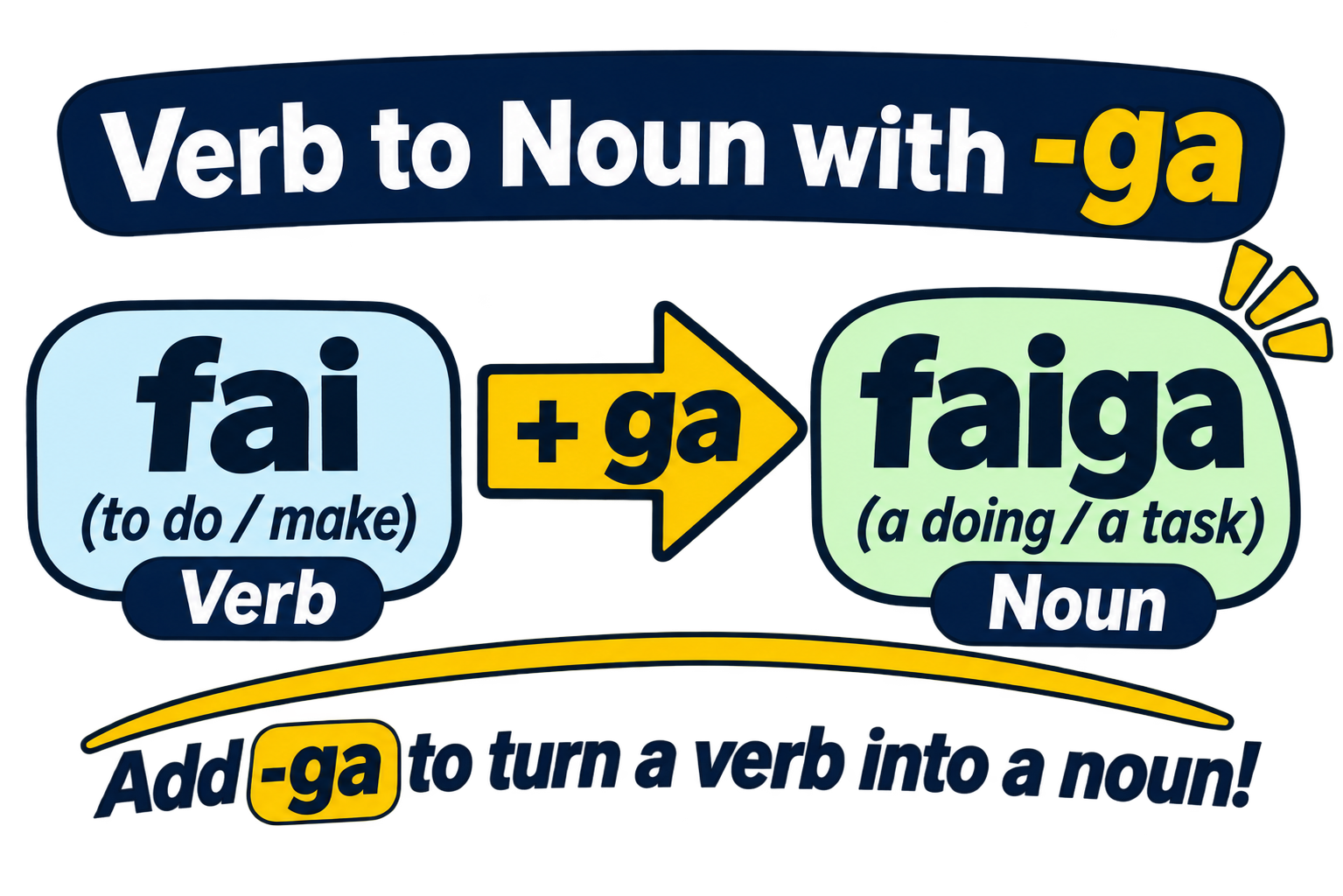
Add -ga to the end of a verb and it stops being an action and becomes a thing: the act itself, the result of it, the place where it happens, or the event built around it. Galue means “to work.” Galuega means “work”: a job, a task, the thing you show up to every morning.
This isn’t vocabulary trivia. It’s sentence structure. A verb lives in the action slot of a Samoan sentence, right after the tense marker. A noun lives after an article like le or se. When you add -ga, you move a word from one slot to the other.
- E ta’alo tamaiti. The children are playing. (ta’alo is the action.)
- Ua uma le ta’aloga. The game is over. (ta’aloga is the thing.)
Same root, different job in the sentence. Once you see that, every verb you learn can double your vocabulary.
Vocabulary: verbs that become nouns
| Verb | Meaning | Noun with -ga | Meaning | What changes |
|---|---|---|---|---|
| ola | to live | olaga | life | Living becomes a whole lifetime |
| galue | to work | galuega | work, job | The action becomes a task or occupation |
| ta’alo | to play | ta’aloga | game, sport | Playing becomes the organized activity |
| moe | to sleep | moega | bed | The action becomes the place it happens |
| a’o | to learn | a’oga | school | Learning becomes the place of learning |
| fa’amatala | to explain, tell | fa’amatalaga | explanation, story | Telling becomes what is told |
| fa’aipoipo | to marry | fa’aipoipoga | wedding | Marrying becomes the event |
| fa’amāvae | to say goodbye | fa’amāvaega | farewell | Saying goodbye becomes the occasion |
| mafaufau | to think | mafaufauga | thought, idea | Thinking becomes what you think |
| filifili | to choose | filifiliga | choice; election | Choosing becomes the choice made |
| sauni | to prepare | sauniga | preparation; ceremony | Getting ready becomes the service itself |
| tāfao | to stroll, go out | tāfaoga | outing, vacation | Going out becomes the trip |
| fa’amoemoe | to hope, expect | fa’amoemoega | hope, purpose | Hoping becomes a goal |
| tofi | to appoint, assign | tofiga | appointment, role | Assigning becomes the position given |
Watch for the variations
Sometimes a consonant slips in before the suffix. Fono (to meet) becomes fonotaga (a meeting), and the prayer word tatalo gives us tālosaga (a prayer or request). Those forms are learned word by word, but the logic never changes: action becomes thing.
One caution: not every word ending in -ga is a simple verb-to-noun pair. ‘Aiga means family, not just “eating.” Learn each new noun inside a sentence so its meaning sticks.
Practice it
Build your sentences in pairs, one with the verb and one with the noun:
- Ou te galue i le Aso Gafua. I work on Monday.
- O la’u galuega lea. This is my job.
- Sa moe le pepe. The baby slept.
- Ua sauni le moega. The bed is ready.
Notice what happened in that last pair: sauni is working as a verb (“is ready”) while moega sits in the noun slot after le. That’s the whole system in one sentence.
Next time you learn a Samoan verb, ask yourself one question: What’s the thing? Add -ga, put it after le, and build a sentence. You just learned two words for the price of one.